







Officials said Tuesday night’s tsunami advisory represented a good test of British Columbia’s emergency response, and the system appears to work well — though some municipalities say more could be done to improve communication with the public.
The tsunami advisory for B.C.’s coast was cancelled Wednesday morning, after the advisory was issued the previous evening following a magnitude 8.8 earthquake off the east coast of Kamchatka, Russia.
Speaking in Kitimat Wednesday, Premier David Eby called the tsunami threat a “trial run.”
Eby said the province took a precautionary approach in its response, and the warning system worked as expected.
“Fortunately we saw minimal impact here in B.C., but we were prepared for a more significant impact if it happened,” said Eby.
David Eby comments on tsunami advisory:
B.C. officials initially issued a tsunami watch after the massive quake that took place a little before 4:30 p.m. PDT.
That was later upgraded to an advisory, telling people along the coast to avoid beaches, stay out of the water and watch out for further alerts from emergency officials.
The advisory included the North Coast and Haida Gwaii, Central Coast and Northeast Vancouver Island Coast including Kitimat, Bella Coola, and Port Hardy.
It also covered the West Coast of Vancouver Island from Cape Scott to Port Renfrew, and the Juan de Fuca Strait from Jordan River to Greater Victoria.
EmergencyInfoBC said in the advisory no significant inundation was expected, but warned about strong localized currents.
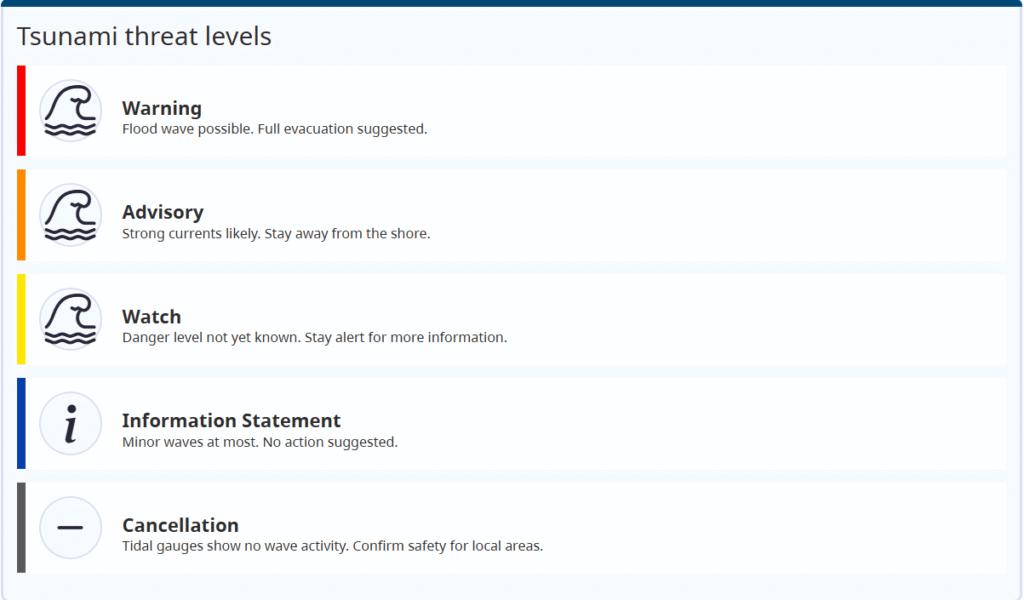
B.C.’s warning system issues a tsunami watch when the danger is not yet known, and tells people to stay alert for more information.
A tsunami advisory means strong currents are likely, and people should stay away from the shore.
The highest alert level is a tsunami warning, issued when a full wave is possible, and evacuations might be necessary.
“We used the data from the National Tsunami Warning Center (NTWC) to monitor and assess the potential impact to coastal B.C. and determine the appropriate level of response,” said Emergency Management Minister Kelly Greene in a statement. “This event is an example of how our systems are working well to keep people informed and safe during a potential emergency.”
The said the province will be conducting a review of the response, which is done after any emergency event.
“Thankfully, the advisory was cancelled, but yesterday’s event serves as a reminder that parts of B.C. are in tsunami risk zones, and people should be prepared. I encourage everyone to learn more about what to do in the event of a tsunami warning at PreparedBC.ca/Tsunamis and visit EmergencyInfoBC.ca online,” said Greene.
Municipalities report smooth response, but communication gaps remain
The District of Tofino said on its Facebook page Wednesday morning the area experienced minimal wave activity overnight, with a maximum height of about 15-centimetres.
Tofino Mayor Dan Law said the emergency response went smoothly. He said councillors heard about the tsunami threat during a council meeting, and the district’s emergency operations centre was immediately activated.
In addition to social media alerts, Tofino uses an alert system called Voyant to communicate emergency notifications to residents who have registered online.
Law said Tofino community hall was opened for community members and visitors to get information and support. He said some tourists did voluntarily leave their lodgings near the shore and remained at the hall until about midnight, though he wasn’t able to say how many people did so.
“Everytime there’s an event like this and our emergency operation centre is activated, it’s an excellent opportunity for our communication policies…to get better. It’s a great opportunity for the district to work with partnering agencies like the RCMP and the Coast Guard to improve those communication channels,” said Law. “That’s going to make all the difference when we get an emergency that is a higher risk.”
Port Hardy Mayor Pat Corbett-Labatt agrees the response appears to have been effective.
She said there was quick action by emergency personnel in Port Hardy to prepare for a possible evacuation, and officials received updates from the province about every half hour.
She said about 100-200 people were camping along beaches in the area, and personnel went out to inform them to move to higher ground.
But Corbett-Labatt said there are some gaps in communication with the public she would like to see addressed to prepare for future emergencies. She noted the lack of cell service in some parts of north Vancouver Island could prevent people from receiving alerts or getting help in case of emergencies.
Tsunamis “move faster than you can run,” said earthquake expert
Alison Bird, an earthquake seismologist with Natural Resources Canada, said the 8.8 magnitude earthquake was unique for being one of the largest recorded in the world.
She said a tsunami wave can move about as fast as a jet plane in deep water, but they become even more dangerous when they slow down and build up in shallower areas.
“They always move much faster than you can run, so I always advise people, evacuate before you see the wave because it’s very difficult to get away from these things,” said Bird.
She acknowledges it can be a challenge to reach everyone with warning notifications, and says people should check information from EmergencyInfoBC or download an emergency notification app to get alerts.
But she said that in the case of a major earthquake off B.C.’s coast, the earthquake itself will be the notice that people should get far away from the shore.
“If you feel really strong shaking where it’s difficult to stand and it lasts more than a minute, it could have caused a tsunami and it’s best to just use that as your warning and get to high ground as soon as you can, because you may not have enough time to wait for that official warning from the tsunami warning centre,” said Bird.
Natural Resources Canada says the last megathrust earthquake along the Cascadia fault line took place on January 26, 1700. The undersea fault ruptured along 1000-kilometres from mid Vancouver Island to northern California, and caused a massive tsunami that levelled villages on Vancouver Island.
Experts predict a similar off-shore event is expected at some point in the future.